
Heart Rate and Blood Pressure
I wanted to share with you all the importance of knowing the difference of Heart Rate and Blood Pressure – I took most of this information from my Level 3 Personal Training folder and some from the British Heart Foundation website.
Understanding the difference between blood pressure and pulse
While your blood pressure is the force of your blood moving through your blood vessels, your heart rate is the number of times your heart beats per minute.
- They are two separate measurements and indicators of health.
- For people with high blood pressure (HBP or hypertension), there’s no substitute for measuring blood pressure.
Heart rate and blood pressure do not necessarily increase at the same rate
A rising heart rate does not cause your blood pressure to increase at the same rate. Even though your heart is beating more times a minute, healthy blood vessels dilate (get larger) to allow more blood to flow through more easily. When you exercise, your heart speeds up so more blood can reach your muscles. It may be possible for your heart rate to double safely, while your blood pressure may respond by only increasing a modest amount.
Heart rate and exercise
In discussions about high blood pressure, you will often see heart rate mentioned in relation to exercise. Your target heart rate is based on age and can help you monitor the intensity of your exercise.
- If you measure your heart rate (take your pulse) before, during and after physical activity, you’ll notice it will increase over the course of the exercise.
- The greater the intensity of the exercise, the more your heart rate will increase.
- When you stop exercising, your heart rate does not immediately return to your normal (resting) heart rate.
- The more fit you are, the sooner your heart rate will return to normal.
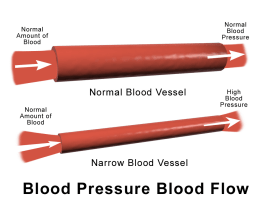
BLOOD PRESSURE
The pressure of blood that is measured by the force – that blood applies to the walls of the arteries as it flows through them.
Blood pressure is measured in millimeters of mercury.
Optimal blood pressure reading is written as 120/80 – these two readings represent systolic and Diastolic pressure readings.
Systolic Blood Pressure – Pressure exerted on the artery walls during contraction of the heart beat. Always the higher reading of the two and always written first. Caused by the increased volume of blood flowing through the arteries with each beat.
Diastolic Blood Pressure – Pressure exerted on the walls of the arteries during relaxed phase of the heart beat. The heart foes through this period of relaxation to allow the chambers of the heart to fill with blood prior to contraction.
Blood pressure is an expression of arterial blood flow and peripheral resistance the blood encounters as it flows round the body. It can therefore be expressed in the following equation:-
BLOOD PRESSURE = CARDIAC OUTPUT X TOTAL PERIPHERAL RESISTANCE
Cardiac output is the volume of the blood pumped out by the heart in one minute – the greater the cardiac output the higher the blood pressure
Total Peripheral resistance is the resistance the blood vessels offer to the blood flow, the greater the resistance the higher the blood pressure . peripheral resistance is increased by constriction or decreased by dilation of blood vessels.
*** If anyone suffers from High or Low Blood Pressure, please make sure you tell a member of Muscle Tone Fitness Staff http://www.facebook.com/muscletonefitness before you start your exercise.







 Muscle Tone Fitness & Massage is ran by a married couple Catherine and Gareth Taylor, they have been going 3 years come March. Catherine started by running Metafit classes in several area to work out which classes worked best, she worked in Springwell Community Centre, Birtley, Chester le Street, Allerdene, Stanley and Burnopfield.



 Muscle Tone Fitness and Massage